
English Rondel Dagger, Circa 1350


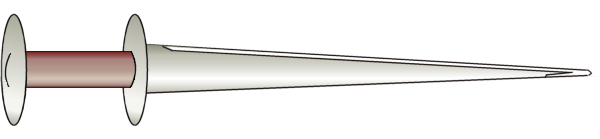
Rondel daggers take their name from the round disks (rondels) of the guard and pommel (1). This one was found in the River Thames and purchased by Jack Williams while he was visiting England in 1995. It dates from the mid-14th century. The overall length of the dagger is 12 1/2 inches. The 8 1/4 inch needle-point blade is diamond-shaped with hollow-ground faces. The guard and pommel are made of brass. An engraving of what looks like a nine-point star can just be made out on the blade side of the guard. The pommel has four petal-shaped segments engraved with lines. Long narrow daggers like this one are designed for thrusting, piercing, and stabbing. The thin, sharp point can fit through gaps in armor and penetrate leather or heavy fabric.
Rondel daggers were worn suspended on the right side of the belt or slung from the front of it. There is some evidence to suggest that rondel daggers were popular with the emerging middle class in the mid-15th century. Merchants and tradesmen can be seen wearing them in a miniature from the Roman de Girart de Roussillon, c. 1448 (2).
| Type: | Dagger |
| Style: | Rondel |
| Country: | England |
| Overall Length: | 12 1/2 inches |
| Overall Width: | 1 5/8 inches |
| Hilt Length: | 4 1/8 inches |
| Blade Length: | 8 1/4 inches |
| Weight: | 8 1/2 ounces |
| Grip: | Missing |
Design and Construction
Beyond the round guard and pommel that give it its name, the rondel is a pure thrusting weapon. In cross-section the blade is diamond, lenticular, or triangular, and it is built to stab rather than cut — delivered underarm, or over the arm in a reverse grip, much like an ice pick. The long, straight blade simply does not lend itself to a slashing action. Some examples are four-edged with a cruciform profile; these are even more purely thrusting, and they foreshadow the 16th-century stiletto. The wide, spherical pommel is not merely decorative — its weight helps drive the point home.
Against Armour
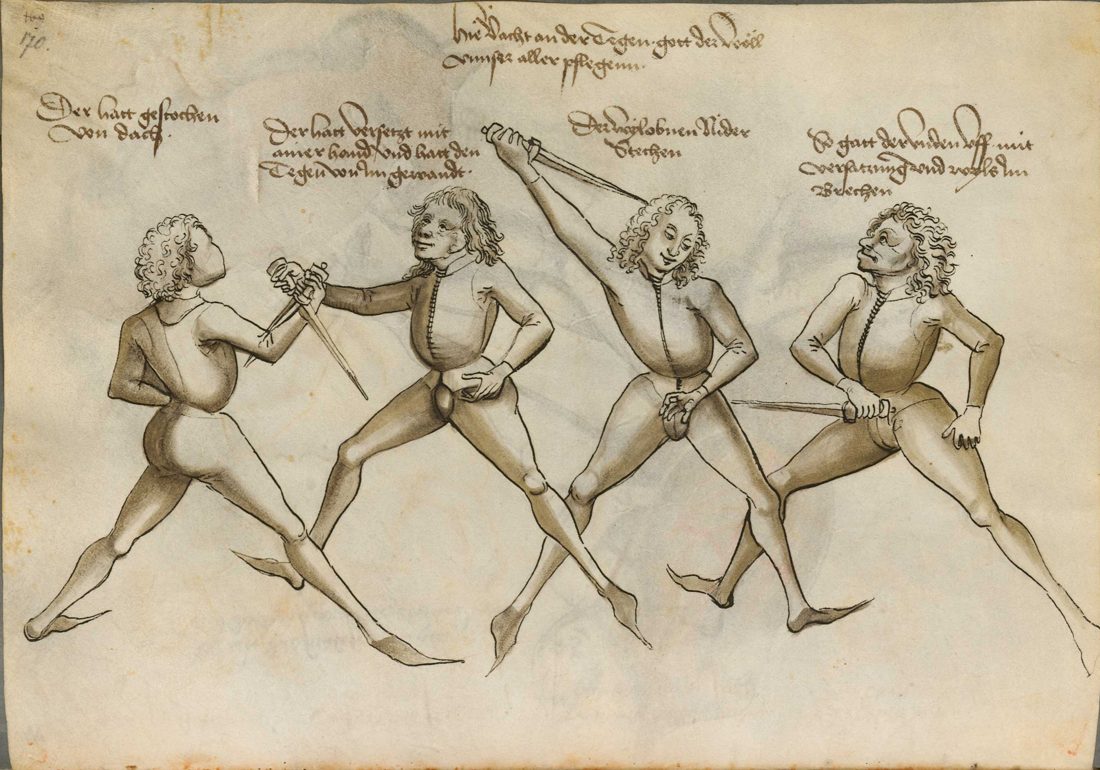
Rondel daggers were made for close-quarters fighting, where a duel often came down to grappling. Their stiff, needle-point blades could puncture and burst the links of mail, and find the weaker points in plate armour — the thinner areas, the gaps, and the joints. As plate improved, a thrusting dagger like this was one of the only weapons that could still breach a fully armoured opponent. The fencing master Hans Talhoffer devoted whole sections of his 15th-century manuals to techniques for fighting with the rondel, both unarmoured and in single combat in armour.
A Knight's Side-Arm
The rondel evolved in the 14th century from the earlier knightly dagger, rising with the spread of full plate armour. By the 15th century it was the standard side-arm for knights, carried into battles such as Agincourt in 1415. At Bosworth in 1485, King Richard III was killed. A 2014 study of his skeleton (published in The Lancet) found the most likely fatal injuries were two wounds to the base of the skull: a deep cut, possibly from a sword or a staff weapon such as a halberd or bill, and a stab from the tip of an edged weapon — the kind of wound a rondel's needle point could make. The cuts to the top of his head were shallow and not fatal.
References
- Daggers and Fighting Knives of the Western World, Medieval Daggers / Rondel Daggers, pages 13–17. Daggers and Fighting Knives of the Western World
- Merchants wearing rondel daggers, miniature from the Roman de Girart de Roussillon, c. 1448. Merchants wearing rondel daggers
- Rondel dagger, Wikipedia. en.wikipedia.org/wiki/Rondel_dagger