
Rifled Pocket Flintlock Pistol by Henry Ellis, Circa 1690
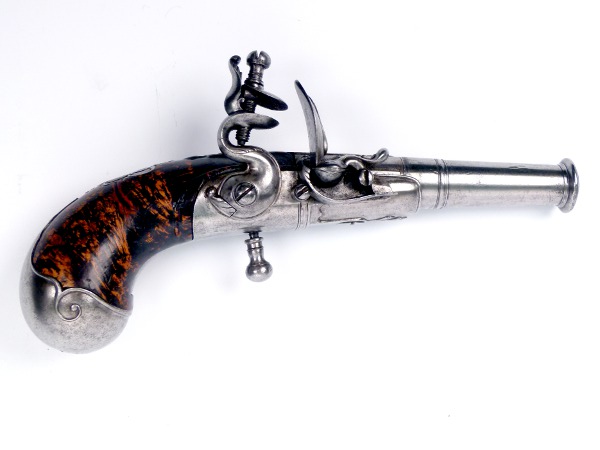
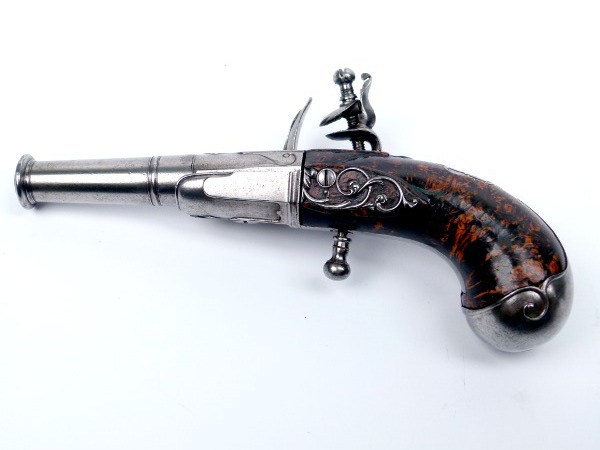
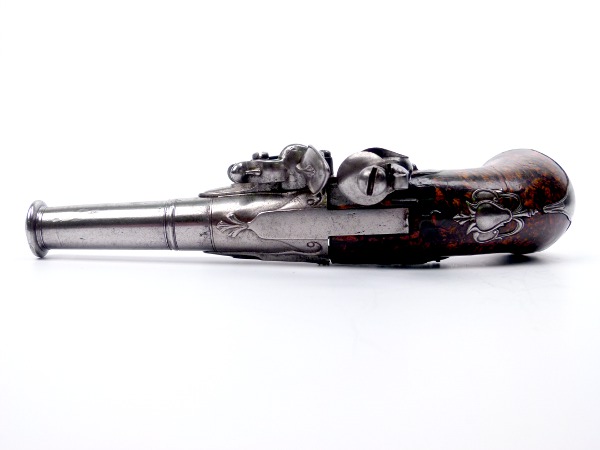
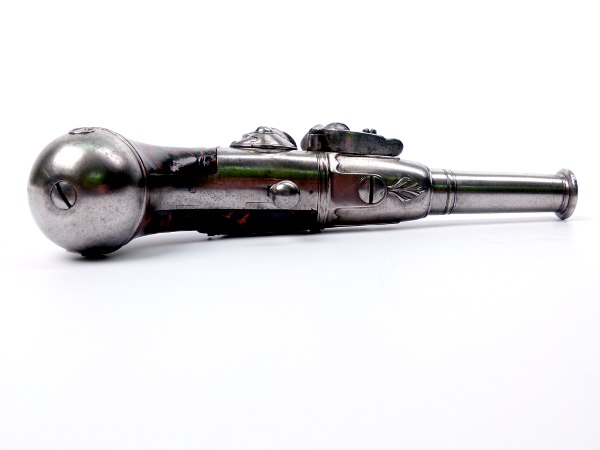
This exquisite flintlock pistol has a rifled turn-off barrel. It predates Queen Anne's reign, which began on March 8, 1702. The pistol was once part of Clay P. Bedford's collection (#1190) and was exhibited at the Metropolitan Museum of Art in the early 1970s. (1) What follows is the museum's catalog description. Cannon barrel rifled with six grooves, in two stages separated by molded girdle, ending in expanded muzzle ring; flattened top at breech terminating in leaf ornament. Dog safety operating between half and full cock; single-leaf upward-curved "steel" spring. Butt of figured burl-walnut; steel furniture; rounded pommel, chased with raised edges and volutes; side plate pierced with floral scrolls; single side nail; blank escutcheon with pierced pendant swags; button trigger; no trigger guard. Henry Ellis, Doncaster, about 1690 (1)
Henry Ellis was one of the most distinguished provincial English gunmakers of the 17th century. His known works seem to date from around 1690 until at least 1712, when he appears as "gunsmith" in the records of the Borough of Doncaster. He was admitted to the freedom of Doncaster on 15 November 1698, and he died in 1722 or 1723. (1) (2) (3)
| Type: | Pocket Pistol |
| Style: | Turn-Off Flintlock Pistol |
| Country: | England |
| Overall Length: | 6 3/4 inches |
| Barrel Length: | 2 3/16 inches |
| Weight: | 11 1/4 oz |
| Bore: | 0.36 inches, Rifled |
| Stock: | Walnut, Ball Butt style |
References
- Rifled Pocket Flintlock Pistol, Number 49, Page 59 (Bedford 1190). Early firearms of Great Britain and Ireland from the collection of Clay P. Bedford
- Henry Ellis of Doncaster, An English Provincial Gunmaker, by Anthony D. Darling, pages 75-89. Arms Collecting Vol. 10, No. 3 (Aug. 1972), Museum Restoration Service, Bloomfield, Ontario
- Henry Ellis, pages 184 and 185. Great British Gunmakers: 1540-1740 by William Keith Neal & D.H.L. Back, Historical Firearms (Oct 1984)
- Clay P. Bedford's Collection of Early Firearms