
Left-Hand Daggers
Origins of the Parrying Dagger
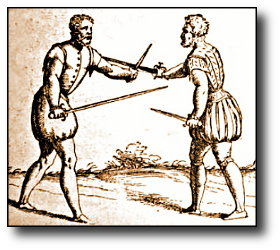
When Christopher Columbus first voyaged to the New World, Spanish swordsmen and pikemen carried daggers that resembled small swords. They had simple, straight, and often short cross-guards (quillons). By the time Hernando de Soto began exploring Florida in 1539, the style of daggers had changed to that of the parrying dagger (parrying poniard or poignard). A two-handed form of personal combat had become popular in Western Europe during the early 16th century. A sword or rapier would be held in the right hand while a dagger was held in the left (1). The daggers were designed to parry or block an opponent's blows and to attack by cutting or thrusting.
Defensive Features
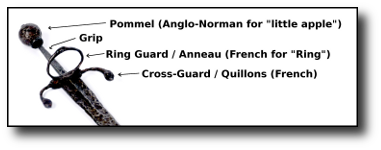
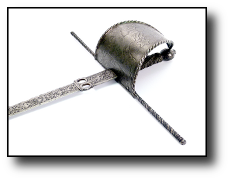
Left-hand daggers included features like side rings (anneau or anneaux), shell guards, and large curved cross-guards. These helped to protect the user's hand, and were meant to deflect or even capture and break an opponent's blade (2).
Depictions of Florida by Jacques Le Moyne
The writings of early explorers have many references to the use of daggers. Unfortunately they don't specify the type of dagger or describe other details like how they were worn.
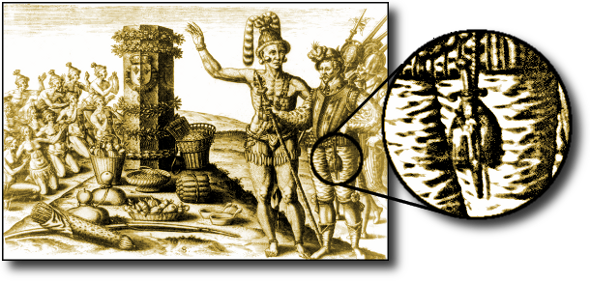
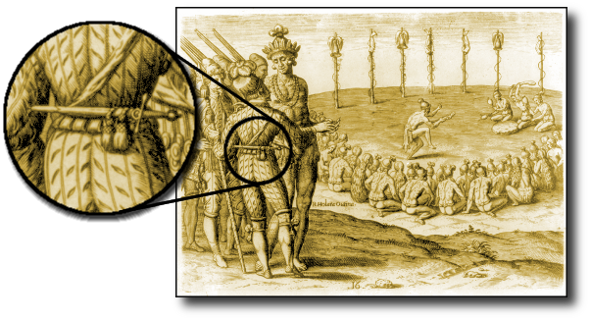
In 1591 Theodore de Bry published an illustrated account of Laudonnière's 1564-65 attempt to establish a Huguenot settlement in Florida. The account was titled Brevis narratio eorum quae in Florida Americai provincia Gallis acciderunt (A Short Narrative of What Happened in the French Province of Florida, America). The illustrations are attributed to Jacques le Moyne (3), but many historians and archaeologists question their authenticity (4). Whether the depictions of Florida are accurate or not, there can be little doubt that the period engravings show how the left-hand dagger was worn at the time.
The Main Gauche
By the beginning of the 17th century the Main Gauche form of the parrying dagger had evolved. These daggers have very long straight quillons and a wide triangular knuckle bow guard (5). Main Gauche means "Left Hand" in French. Today, many people use the term Main Gauche when referring to left-hand parrying daggers in general.
References
- Parrying Daggers and Poniards, by Leonid Tarassuk, The Metropolitan Museum of Art
- True Art of Defense, by Giacomo DiGrassi, 1570, IX. Rapier and Dagger
- Illustrations from "Brevis narratio eorum quae in Florida Americai provincia Gallis acciderunt", The Library of Congress
- The Devil in the Details, by Jerald T. Milanich, Archaeology Volume 58 Number 3, May/June 2005.
- Arms and Armor in Colonial America, 1526-1783, By Harold L. Peterson 1956, page 90 in the 2000 edition