
Misericorde Spanish Dagger, Circa 1520
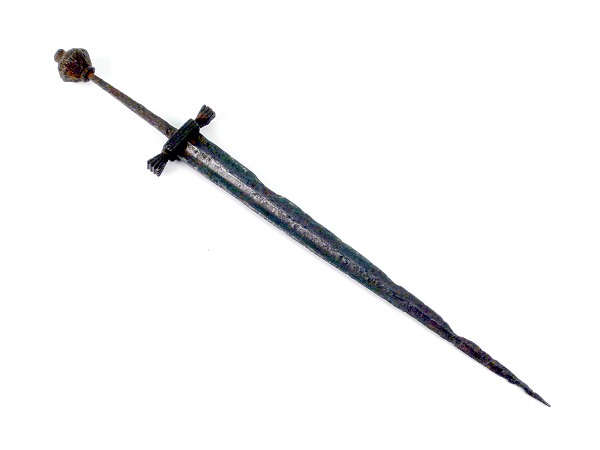
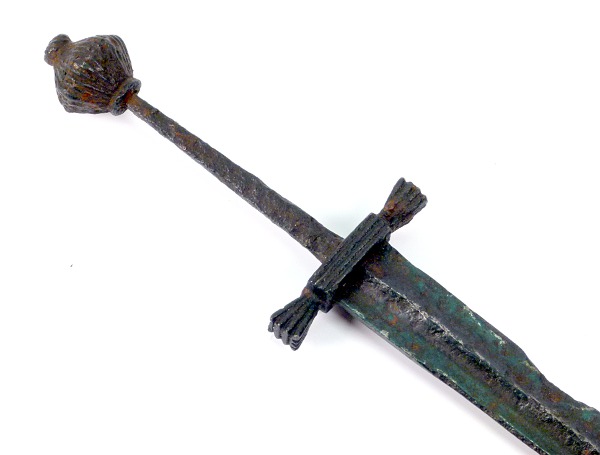
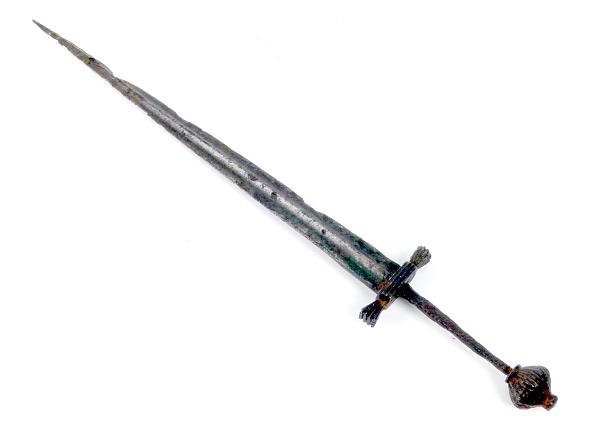
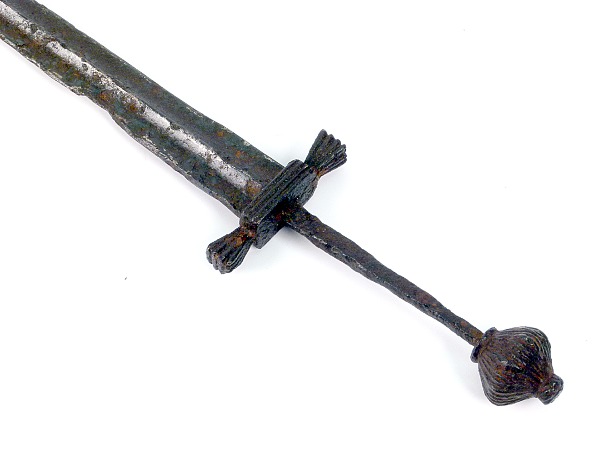
Misericorde (‘mercy’) Spanish dagger, c. 1520 — unearthed near Tampa Bay. A hollow-ground needle-point thrusting blade. The crossguard with its triangular-shaped quillons and the pommel are both decorated with deep accent grooves. Long narrow daggers like this one are designed for thrusting, piercing, and stabbing. The thin, sharp point can fit through gaps in armor and penetrate leather or heavy fabric. This style of dagger was often used to deliver the death blow to a seriously wounded adversary, hence the name misericordia, which is Latin for "mercy". (1)
| Type: | Quillon Dagger |
| Style: | Miséricorde |
| Country: | Spain (?) |
| Overall Length: | 16 3/8 inches |
| Overall Width: | 2 3/8 inches |
| Hilt Length: | 4 5/8 inches |
| Blade Length: | 11 3/4 inches |
| Weight: | 8 1/8 ounces |
| Grip: | Missing |
The Misericorde
In the age of bladed combat, a mortal wound was not always quickly fatal, and the misericorde could also be turned on an active adversary in a struggle. In use, its point was worked through the visor or eyeholes of a helm to the brain, or driven through the weaker points of plate — under the arm, to the heart.

The Quillon Form
The quillon is one of the oldest patterns of the European dagger, and it is the shape the misericorde most often took. Beyond shielding the hand, the projection gives the thumb a place to brace, steadying the weapon in the grip.
From the Middle Ages to the New World
Known from the 12th century, the misericorde appears in the armaments of England, Germany, and Persia, and was carried by Polish knights and princes from at least the 14th century. A Spanish example of this period belongs to the world of the early Spanish colonies of the Americas — the era of the conquistadors.