
Spanish Esponton (Spontoon), Fort Mose, 18th Century
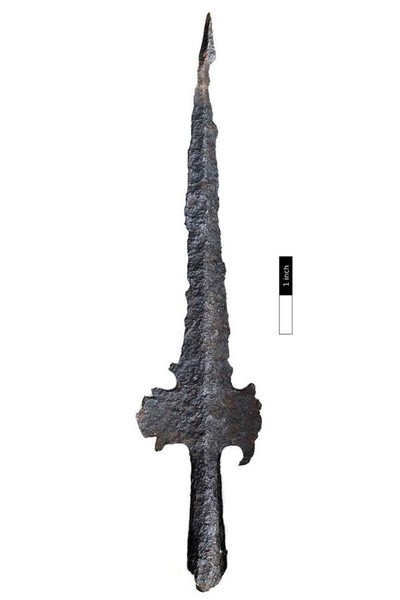
This is the iron head of a Spanish polearm — an esponton, or spontoon — recovered near the site of Fort Mose in St. Johns County, Florida. The head consists of a long, tapering spike rising above a crossguard with projecting side lugs, and a socket at the base for mounting on a wooden pole. The iron is heavily corroded, consistent with long burial in the saline soil of the salt-water marsh north of St. Augustine. It was found by Jack Williams (F.E. Williams III) on property he owned near the fort. The piece is Spanish in origin and dates from the 18th century, the period of the fort's occupation. Because the site was occupied for a long time and polearms of this kind were in use over many decades, its exact date is uncertain; it may have been lost during the Battle of Bloody Mose of June 1740, one of several conflicts at the fort, but that is a guess from where it was found and the period, not a certainty. The English had known the settlement by the names Mosa and Moosa.
The Battle of Bloody Mose
In 1740 the long tension between Britain and Spain over the Florida border erupted into open war. Oglethorpe's invasion opened in May, and before the main assault on St. Augustine he had the old fort of Mose dismantled — its gate burned and breaches cut in the walls — so it could not be turned against him. The people of Mose withdrew into the city and took shelter within the Castillo de San Marcos.
The decisive engagement of the campaign came not at the great fortress but at that dismantled fort. Oglethorpe had left a weak detachment — under a hundred white soldiers with forty-two Indians — to alarm the Spaniards. At dawn the Spanish governor Montiano sent out a force of some three hundred, including the free Black militia of Mose under its captain Francisco Menéndez, and they fell on the British camp in a sudden ambush. In under an hour the fight was over: the British lost their commander, Colonel John Palmer, and a company of seventy-two Scots — Oglethorpe's own bodyguards — surrendered at the point of the bayonet.
It was one of the few victories Spain won on the frontier, and the British gave the engagement the name that stuck: Bloody Mose, or Fatal Mose. This esponton may be a survivor of that fight — or of one of the other engagements at the fort over the decades it was occupied. The battle is described in detail at FortMose.com.
| Type: | Esponton (spontoon) polearm head |
| Maker: | Spanish (unmarked) |
| Date: | 18th century (period of Fort Mose's occupation) |
| Material: | Iron (heavily corroded) |
| Head Length: | approximately 7.5 inches |
| Provenance: | Found near Fort Mose, St. Johns County, Florida |
| Note: | Head only; pole/haft not present |
References
- Brinckerhoff & Chamberlain, Spanish Military Weapons in Colonial America 1700–1821 (1972), p. 106, pl. 206 — a Spanish "esponton."
- FortMose.com — "Bloody Mose" — Oglethorpe's invasion of 1740 and the battle that gave the fort its name.